
Your Certainty Is the Blind Spot
The most dangerous deception in your company is the one your best people are running on themselves. Here is how to catch it, and why the willingness to be wrong is what makes you right more often.

TL;DR. Audiences and boardrooms score certainty, not accuracy, so the most confident voice out-persuades the most correct one. That makes your surest executive your least-audited one, and their conviction your most expensive blind spot. The fix is deception literacy, learning to see the mechanism, pointed in two directions at once: outward, to catch the assumption being exploited in you, and inward, to test the convictions you trust so completely you never check them. Leaders have to model it first, or the people below them won’t dare.
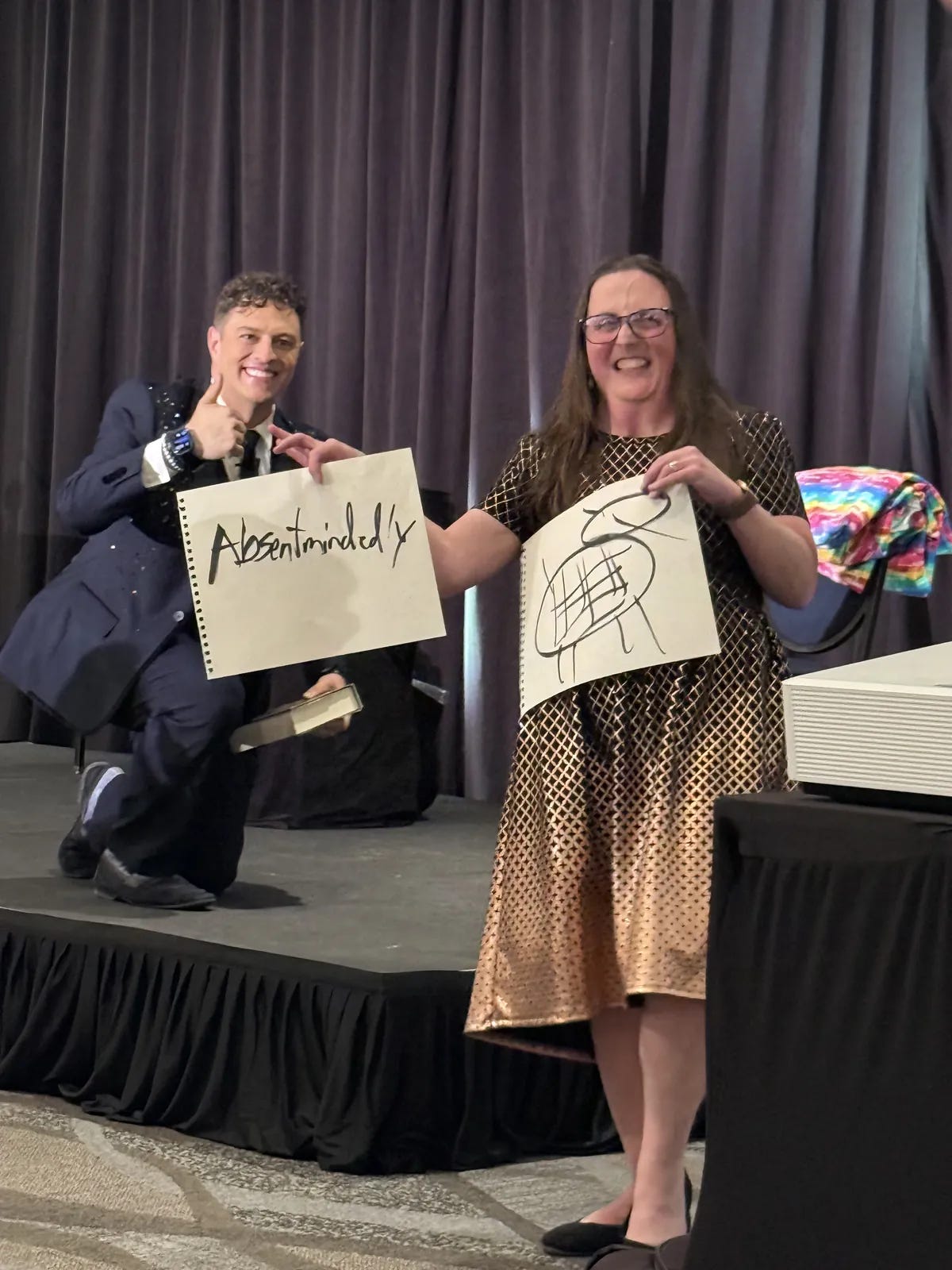
The last time you were certain, were you right, or were you just certain?
Sit with that for a second and let it become uncomfortable. The truth is you can’t tell the difference from the inside. Certainty does not come with a little label that says “tested” or “untested.” It feels exactly the same either way. And that single fact is the most exploitable thing about you.
I know this because manufacturing certainty is my job. I am a mentalist. People pay me to appear to know things I could not possibly know, and the secret is not that I am always right. The secret is what I do when I am wrong. When I land a hit, I sell it with full conviction. When I miss, I do not back down. I hold the same certainty and quietly widen the claim until it becomes true. I tell you there is something weighing on you. You say no. I say, of course, we are not always aware of what is weighing on us, it shows up in our sleep, in our work. You pause, and you say, well, now that you mention it, I have been sleeping badly. And now I was right all along, even though you just told me I was wrong. The miss never registers as a miss. What the room remembers, every time, is that I knew. I am paid to stay certain, and to move the target so the arrow was always in the center. The gap between being right and looking right is wider, and more useful, than almost anyone in business realizes.
The room scores certainty, not truth
Here is something every working mind reader knows, and most leaders never learn. A mind reader who is right sixty percent of the time but never breaks conviction on a miss and instead widens the claim until it lands will be remembered as more accurate than one who is right ninety percent of the time but noticeably hedges. The room does not keep score the way a statistician would. It scores a stream of moments, and it remembers the ones that were sold most fully. A miss, handled without ever dropping certainty, does not register as a miss at all. It becomes a hit you simply had to broaden to reach. The hits get amplified, the misses get reabsorbed, and the spectator quietly edits their own memory to match the most confident delivery.
This equation persists beyond the stage as well. Walk it into a boardroom and nothing changes except the stakes. The most confident voice out-persuades the most correct one, every single time, because conviction reads as competence. We are wired to treat certainty as a signal of expertise, when it is often just a signal of certainty.
This is not a hunch. Philip Tetlock, in his landmark study Expert Political Judgment (2005), spent more than two decades scoring the forecasts of hundreds of experts, and his headline finding should be taped to every conference room door. The most confident experts, the ones who ran everything through one big confident theory, were measurably less accurate than the more self-questioning ones. And audiences preferred the confident ones anyway. We reward the trait that predicts being wrong.
Why being smart does not protect you
The reflex here is to think this happens to other people. Less informed people. Not you.
A rocket scientist gets taken by a card scam, because she knows rocket science, not card scams. Intelligence does not transfer across domains of deception. Each con exploits a different default in the mind, one that fires before you are even aware of it, so general brilliance buys you nothing against a specific mechanism you have never studied. Smart executives are not harder to fool. They are fooled through different doors, the framed proposal, the confident hire, the dashboard built to steer your attention, the peer who mentions they “already did this.” The smartest person in the room is not harder to fool. They are fooled through a door they never thought to lock.
There is a name for the skill of knowing where the doors are. Call it deception literacy. It is knowing how a cold read, a con, a manipulated metric, and a persuasion script actually work, in enough detail to recognize one in motion. It belongs on the executive competency list right next to finance and strategy, and almost nowhere is it taught. We will send a leader to a week of negotiation training and never once teach them how they get played.
It is not just the boardroom
You have watched this happen a thousand times without naming it. Think about our politics for a moment. A claim gets made with total confidence. It turns out to be wrong. And instead of a correction, the goalpost quietly slides, the claim widens, and the conviction never breaks. It has become so ordinary that most of us no longer notice it happening at all.
Here is the test, though. As you read that, you almost certainly pictured one side. The side you are not on. That reflex, the certainty that it is obviously them and not us, is the exact blind spot this whole piece is about. Everyone can see it in the other party. Almost no one can see it in their own. That is what makes honest self-assessment so uncomfortable. We can see this in other leaders and easily miss it in ourselves.
The most expensive deception turns inward
Here’s where I’ll make it even more uncomfortable. The most expensive deception in your life is not the one someone runs on you. It is the one you run on yourself, and you defend it hardest precisely because you cannot see it.
I know this because I lived inside one for most of my life.
I grew up certain about how the world worked. Not certain the way you are certain about a fact you could look up, I was certain the way you are certain about gravity. It was not a belief I held. It was the air. I never questioned it because it never occurred to me that it was a question, and from the inside, that is exactly what total certainty feels like. Not like conviction. It feels like reality.
It was also costing me everything. There were parts of who I was that did not fit the rules I had been handed, and rather than question the rules, I questioned myself, for years. There’s a saying, you cannot read the label from inside the jar. I did not even know I was in one.
What finally broke it was not a better argument. It was permission to ask one question I had never let myself ask: what if this isn’t true. The moment I tested the thing I was most sure of, the certainty that had run my life turned out to be an assumption I had simply never audited. Everything I do now started the day I was willing to be wrong about the thing I was most sure I was right about.
That is the method. Not being smarter but being willing to test the conviction you trust the most, because that trust is exactly what keeps it from being tested.
Now examine your own organization and see if this sounds familiar. The executive whose certainty everyone relies on is the one whose claims get questioned least. The strategy nobody challenges is not the strongest one, it is the most defended one. Sound familiar?
Chris Argyris spent decades at Harvard documenting why. In his 1991 work on why smart people struggle to learn, he found that the highest performers are often the worst learners, because they have rarely failed, and so they never built the muscle to learn from failure. The moment they are challenged, they reason defensively. And defensive reasoning is a closed loop. It seals itself. The response to being shown you are wrong is to get more sure.
This is the same move I make on stage when I miss. I hold my certainty and widen the claim until I was right all along. The only difference is that I know I am moving the target. The defensive executive runs the identical play, reframing a miss until it counts as a hit, and genuinely believes the target never moved. That is what makes it so expensive. A magician’s goalpost shift is a technique. A leader’s is a blind spot.
The observer’s version of this has a name: the halo effect. The psychologist Edward Thorndike first documented it in 1920, and Phil Rosenzweig later applied it to business. When results are good, we look at a company and decide the leader is visionary, the strategy brilliant, and the culture strong. We are not really evaluating those things; we are reading them backward from the results. And that is what kills scrutiny. A leader riding a good quarter is the person we question least, because success makes every one of their judgments look already proven. The certainty that most needs auditing gets audited least, precisely when nothing is forcing the check. The blind spots remain until a bad quarter comes, then everyone asks why they couldn’t see it coming.
Deception literacy is not only about the con someone runs on you. It is about the one you run on yourself. And the defense is the same both internally and externally. You have to be able to see the mechanism.
The same move that fools you can set you free
Here’s how to turn this from warning into an advantage.
Every magic trick works the same way. It does not add something impossible to the world. It quietly violates a rule the room did not know it was holding. That the deck is ordinary. That the coin is still in the hand. That the choice was free. The wonder you feel as a result is the gap between the assumption you were carrying and what just happened in front of you.

Real innovation runs on this identical principle. You do not exceed expectations by pushing harder against the existing ceiling. You trace the expectation back to where it came from, and when the honest answer is “tradition” or “we have always done it this way” or “no one ever asked,” you throw the rule out, and the ceiling turns out to have been imaginary the whole time. The most valuable question in any organization, team, or process is not “how do we do this better.” It is “why do we assume it has to be done this way at all.” Magic is just that question, performed.
So the skill that protects you and the skill that frees you are the same skill, pointed in two directions. Deception literacy turned outward catches the assumption someone is exploiting in you. Turned inward and forward, it becomes innovation and it happens when you deliberately hunt the assumption your whole team treats as a law of physics, and you violate it on purpose.
There is a simple drill for finding it. Take a rule that feels absolute in your team and ask why it is there. Then ask why of the answer, then ask why four more times. By the fifth why, the unspoken assumption underneath the rule is sitting in the open where you can finally look at it. Most rules were rational responses to a problem that may no longer exist. The five whys exercise drags that into daylight. Then you ask the magician’s question: what if there is a better way.
The test that beats conviction
This is the discipline my framework calls Explore What’s Possible, and it is the antidote to certainty. The answer is not more confidence, it’s more testing.
Argyris pointed out that we already know how to do this. In strategy, finance, and operations, we collect real data, make our assumptions explicit, and submit our conclusions to the toughest tests we can find. Then we walk into a conversation about people, or culture, or a leader’s pet theory, and all of that rigor evaporates. The claim “the client wasn’t really committed” gets treated as a conclusion when it is an untested inference. Productive reasoning just means holding our human claims to the same standard we already hold our spreadsheets.
David Garvin and Michael Roberto drew the cleanest line through this. Most teams make decisions through advocacy, where people treat the decision as a contest, argue for their preferred answer, and present only the evidence that helps their side. The alternative is inquiry, where the group tests options together to find the best one rather than to win. The difference is not how smart the room is. It is whether the room is trying to be right or trying to win.
So here is the portable rule, the one thing to take into your next meeting. Make confidence the trigger for evidence, not the substitute for it. When a claim arrives wrapped in the most certainty, that is the claim you test first, not the one you wave through. Ask your highest-conviction people for their evidence precisely because they are confident, not in spite of it. You are not punishing certainty. You are auditing it before it costs you.
Why this has to start at the top
There is a catch, and it is the reason this cannot be delegated downward.
The behaviors we are talking about, admitting you do not know, asking what if, testing your own convictions out loud, sitting in being wrong for a moment, all of them require a person to be a little vulnerable in public. And vulnerability only flows downhill safely. When a junior person tries it and the leader above them is still reasoning defensively, the junior person gets burned, and the whole organization quietly learns that wonder is unsafe. Argyris saw this clearly: a transformation in reasoning that starts at the bottom looks strange, even dangerous, to a defensive senior layer, and they disown it.
It is something I have seen personally in organizations and for one of them, that mistake cost them millions of dollars and critically damaged their reputation.
So it has to start at the top. Not because leaders matter more, but because they set the safety ceiling for everyone beneath them. The leader who can be seen testing their own certainty gives everyone else permission to test theirs.
That does not mean change is top-down forever. It only means the permission is. Leaders model the move first, which makes it safe, and then it spreads outward person to person until it reaches the tipping point where it becomes simply how the place works. Research on how conventions actually flip, published in Science in 2018 by Damon Centola and colleagues, puts that threshold at about a quarter of the group, roughly 25 percent. You do not need everyone. You need the top to go first and enough of the room to follow. This is how you create a culture of learning throughout your entire organization.
What this means for your next meeting
You do not have to become more skeptical. Skepticism is just defensiveness with better posture. You have to become better at being fooled, the way the happiest person at a magic show is the one who lets go and lets the wonder in, and then gets curious about how it worked.
Start here. The next time you notice you are certain, ask one question before you act on it: am I right, or am I just certain. Then find one claim or process in your week that everyone treats as obvious, the one nobody tests because it feels too settled to question, and run the five whys on it. One audited conviction. One violated assumption. That is the whole practice, and it is the difference between a leader who defends the ceiling and one who discovers it was never real.
Your certainty is not your strength. Your willingness to test it is.
Frequently Asked Questions
Q: Why does confidence beat accuracy?
Because people score certainty, not truth. We are wired to read confident delivery as a signal of competence, so the most confident voice is remembered as the most accurate one even when it is not. Philip Tetlock’s long-running forecasting research found that the most confident experts were measurably less accurate than more self-questioning ones, and audiences preferred them anyway.
Q: What is deception literacy?
Deception literacy is knowing how influence and deception actually work, cold reading, cons, manipulated metrics, persuasion scripts, in enough detail to recognize one while it is happening. Intelligence does not protect you, because each deception exploits a different mental default that fires before awareness. The only durable defense is knowing the specific mechanism.
Q: Why are smart, successful leaders often the worst at learning?
Chris Argyris found that high performers have rarely failed, so they never developed the ability to learn from failure. When challenged, they reason defensively, and defensive reasoning is a closed loop that seals itself off from correction. Their certainty gets audited least precisely because everyone trusts it most.
Q: How do you test a conviction without becoming cynical?
Make confidence the trigger for evidence rather than the substitute for it. When a claim arrives with the most certainty, test it first. Use inquiry, testing options together to find the best answer, rather than advocacy, arguing to win. This audits certainty without treating everything as a threat.
Q: What does a magic trick have to do with innovation?
Both work by violating an assumption the room did not know it held. A trick breaks a hidden rule (the deck is ordinary, the choice was free). Innovation breaks a hidden business rule (we have always done it this way). The highest-leverage question is not “how do we do this better” but “why do we assume it has to be done this way at all.”
Q: Why does this kind of change have to start at the top?
Because the behaviors involved require public vulnerability, and vulnerability only flows downhill safely. If a junior person tests their certainty in front of a defensive leader, they get burned and everyone learns it is unsafe. Leaders set the safety ceiling, so they have to model the move first, after which it can spread through the organization.
Sources
Argyris, C. (1991). Teaching Smart People How to Learn. Harvard Business Review, May-June 1991.
Cold reading mechanics: Rowland, I. The Full Facts Book of Cold Reading.
Müller-Lyer illusion: Illusions Index, Müller-Lyer Illusion.
Next week I’m running this in reverse: what your reaction to a magic trick reveals about how you lead, and how to train the wonder that defensiveness keeps stealing from you. Subscribe so it lands in your inbox.